Boost your business with AI predictive analytics
AI and its boom in the business world
Difficult to contradict: in the current commercial landscape, artificial intelligence (AI) is a must for digital transformation. But what does it actually bring?
Among an incalculable number of AI uses we can cite, its ability to optimize decision-making processes, automate repetitive tasks, and improve the accuracy of analyses (while reducing turnaround times) is particularly relevant for businesses. AI is not just about enhancing the efficiency of a business. It is undeniably crucial to improve your competitive position in the market.
Do you need figures to corroborate these propros? According to a study published in the Quarterly Journal of Economics in 2024, the use of conversational AI (i.e. an AI that interacts with users via text or voice) has increased the productivity of customer support agents by an average of 15%. Similarly, a experience with GitHub Copilot (the famous AI that serves as programming support) showed that developers complemented a 55% faster programming task with AI.
These figures show you that company AI offers (1) a definite advantage in your operational efficiency, and (2) a serious competitiveness boost. The chart below shows the time saved by the time of use of the general AI (e.g. ChatGPT) for different sectors of activity. You can very clearly see the dynamic that the time saved is correlated with a strong use of AI.
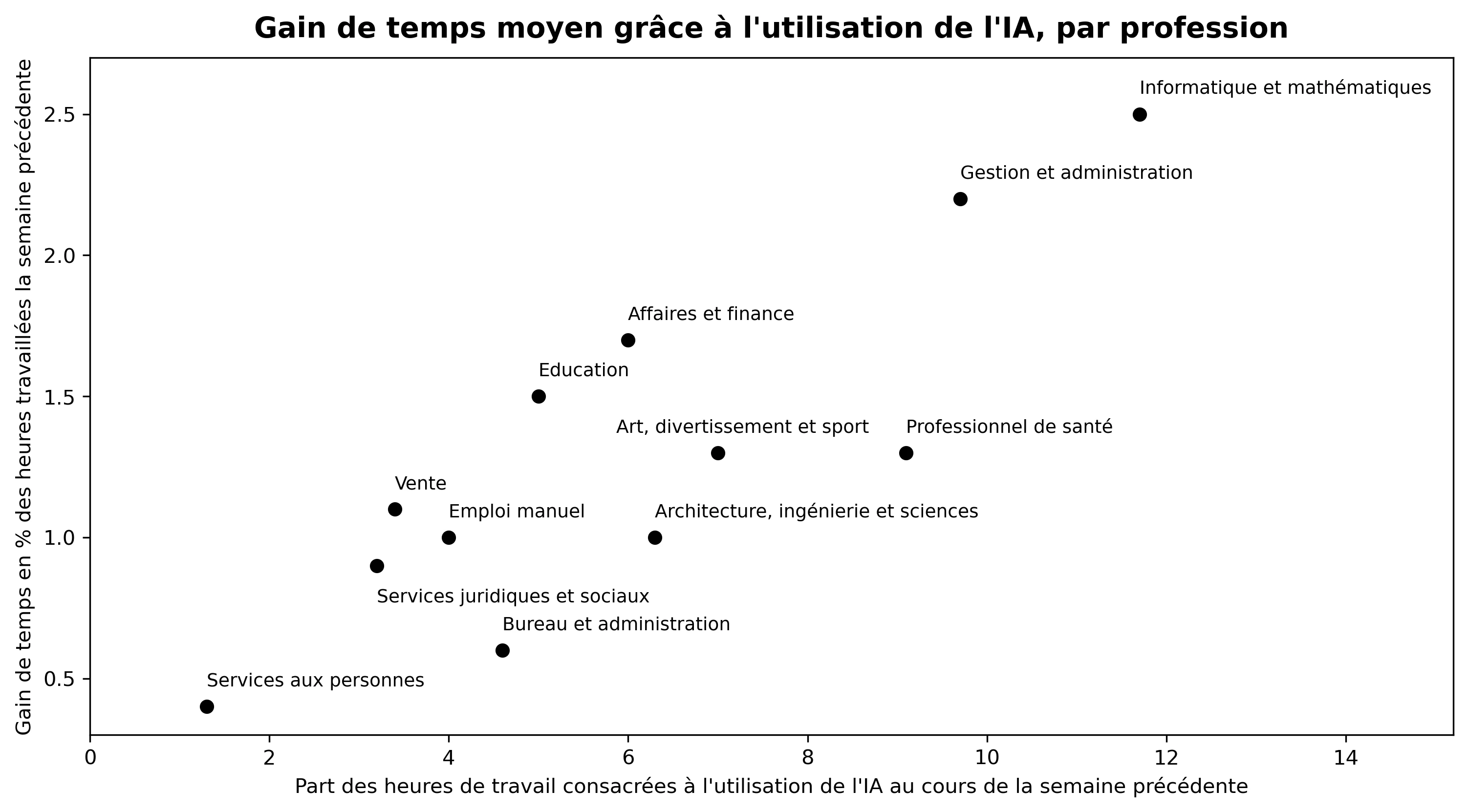 Average time saved through the use of AI, by profession (source)
Among the many applications of AI, we would especially like to talk to you today about predictive analytics. That is, AI's ability to anticipate future trends, which allows both to guide your strategic decisions, but also to identify new opportunities, all by mitigating risks.
For example, it is well known that Amazon uses predictive analytics to optimize its supply chains, reducing costs and increasing margins. The result? A formidable efficiency.
In a rapidly changing technological environment, integrating AI is no longer really an option. This will not only help you to remain relevant, but also provide increased value to your customers.
In this article, we will see in particular:
- What predictive analytics is and how it can be relevant to your business
- How to implement predictive analytics with AI within your company
- The few challenges that can be faced when adopting predictive analytics by AI
- The future of predictive analytics
Predictive analysis with AI and its potential for your business
Predictive analysis is therefore briefly defined as the use of artificial intelligence to transform historical data (for example, your sales per month, your raw material quantity,...) into predictions to anticipate the future. A bit like fortune telling, but here taking into account the most likely future on the basis of historical data. But why is it crucial for your business? To remain competitive, you have no choice: informed decision-making is essential.
Using predictive analytics by AI within your company offers in particular (1) a significant reduction in uncertainty (and therefore less stress for you) and (2) a conversion of unused data volumes into forecasts that are exploitable. Need a more concrete example? In retailing, this technology anticipates consumption trends, which allows you to optimize your inventory and customize your marketing. Rather interesting, isn't it?
Another example would be from a financial point of view. Predictive analysis identifies irregularities in transactions, allowing you to manage risks differently and make accurate decisions. Anyway, you'll have understood, everyone wins!
We would like to point out, however, that predictive analytics allows for a prediction of the most probable future possible. Some factors are often impossible to take into account, so predictions will necessarily contain some uncertainty. Nevertheless, this remains more relevant than making decisions with closed eyes.
If you work with AI experts to put in place a predictive analytics tailored to your business, it quickly becomes a very powerful strategic asset in your digital transformation. But what are the steps for this implementation?
How to implement AI predictive analytics in your business?
First of all, it is necessary to evaluate your operations. This means identifying parts of your business where more accurate forecasts can really make a difference. At this point, don't think about AI. Just think about each place in your business where (1) you have access to a certain amount (even a small amount) of data, and (2) you would like to have a crystal ball to read the future.
If this doesn't seem very concrete, here's an example. Think about stock management or marketing customization. Two parts of an activity where one would clearly like to know in time what users will think or consume. In addition to this, the data are easily accessible: just look at the figures of previous years (whether it is the number of sales, the quantity of a stock, ...).
Then you need to clarify your available options. For example, you can:
- Opt for SaaS platforms that are ready for use (if your problem is not highly specific to your company and if a software is available).
- Or you can also consider creating tailor-made solutions with experts. It's obviously more expensive, but the return on investment is usually worth it. Simply make sure that these custom made AI solutions easily integrate with your current systems.
Finally, don't neglect the training of your teams. It's crucial. Use in-house experts to get the most out of these technologies, regardless of whether you've chosen a ready-made solution or invested in a tailor-made solution. You thus promote a data-driven culture, which translates into a fluid adoption of AI, and therefore necessarily also an optimal ROI.
Common challenges in adopting predictive analytics AI
As we have thus seen, the implementation of predictive analytics based on AI can truly transform the decision-making processes of companies. But before we start creating an AI predictive analytics solution, it is necessary to clarify the main obstacles to this implementation.
First of all, no AI without data. It's a bit like a car without gas: it's visually interesting, but completely useless. The quality of this data is just as essential. Wrong or misstructured data? This can lead to inefficient models, if not completely biased, which would be detrimental to increasing productivity for your company.
Who says data also says security in relation to these data. It is quite normal if one of your main concerns when talking about predictive analytics by AI is protection in relation to your data. Indeed, respecting standards such as GDPR is not only legal but also ethical. And even if your data does not necessarily affect user data, we can understand that some data is private property of the company.
But what is the solution in this case? Either you have opted for a SaaS-type software with which the conditions of use are clear in relation to the use of your data. Either, you can also host your own AI solution for predictive analytics internally. In this case, no risk of data leakage. Only you can access it.
What future for predictive analytics AI?
AI's predictive analytics continues to grow, but will this trend continue in the years to come?
To anticipate if the predictive analytics by AI will always have a future and will continue to be adopted by a large and growing number of companies, we must first understand the two pillars on which it is based: machine learning and big data.
The machine learning, first of all, allows an AI to learn (hence the term "machine learning") and to improve without explicit human intervention. This offers (1) increased precision and (2) remarkable adaptability. An absurd amount of investment has been made in this area in recent years, and with the massive hype around AI, it is very likely that this is still the case in the future. This first pillar is therefore guaranteed to always make predictive analytics evolve in the future.
As for big data, it is simply the massive data (or not, depending on the case of use) needed to drive these models efficiently. As long as there are data (which will always be technically the case), this area will continue to develop.
In short, the predictive analytics by AI is therefore not ready to end, and we believe that it is only in this first step. Only the future will tell us. In the meantime, the future of predictive analytics is clearly promising. Those who can grasp this technological revolution will certainly position themselves as leaders in their respective markets.
Adopt AI predictive analytics today
In today's business world, predictive analytics AI is an essential lever. As we were able to say in this article, this not only gives you (1) an anticipation of market developments, but (2) it also allows you to make informed decisions. Transforming your historical data into useful forecasts? Yes, it is now possible.
By integrating AI into your decision-making processes, you will limit uncertainties (and therefore less stress for you). It is also an opportunity to optimize your operations, and thus to improve customer satisfaction.
In addition, today, the AI tools are easily integrated with existing digital infrastructures. No more excuses about the complexity of a project.
Investing in this technology is therefore above all a strategic investment. You equip your company to navigate in an uncertain future, but with serenity.
So, collaborate today with experts in AI solutions (us, preferably, but we won't blame you if you prefer other experts, we promise). Not just a question of innovation, it's insurance for the growth of your organization.